How to Apply for a KfW Student Loan: Your Step-by-Step Guide

Reading time: 8 minutes
Are you thinking about applying for a KfW student loan but aren't sure how the process works? The KfW student loan application is easier than you think once you know which steps are involved. This guide shows you exactly which documents you need, where to submit your application and what happens after you send it in.
The KfW student loan from Germany's state-owned development bank is one of the most popular student loans in Germany. With a current effective annual interest rate of 5.37% (as of March 2025, source: KfW Bankengruppe), more than 100,000 students finance their studies this way every year. The special thing about it: you can choose between 100 and 650 euros a month, regardless of your parents' income.
What makes the KfW student loan special?
Before we get into the application process, it helps to understand why this loan is such an attractive option. Unlike private student loans, KfW does not run a credit check on students. You don't need collateral and you don't have to prove a regular income. The development bank finances first and second degrees, even if you have already completed vocational training. You can find more details on how to fund a second degree after vocational training in our separate guide.
Payouts go directly into your account every month. You choose the amount yourself, anywhere between 100 and 650 euros. Funding runs for a maximum of 14 semesters for a first degree. For a master's degree you can finance up to 6 semesters. Important: you must be between 18 and 44 years old when you apply.
Step 1: Check that you meet the requirements
Before you start your KfW student loan application, run through these basic requirements. You must be enrolled at a state-recognized university in Germany. Universities of applied sciences, universities, cooperative state universities and vocational academies all qualify. Distance learning programs are also funded as long as the institution is state-recognized.
Your citizenship matters. German citizens are automatically eligible. EU citizens must have lived in Germany for at least three years. Foreign nationals who grew up and went to school in Germany (so-called "Bildungsinländer") with a residence permit may also be eligible. If in doubt, check your individual situation directly on the KfW website.
First-semester students are not checked for academic progress. From the 2nd semester onward, however, you have to prove that you are studying. The KfW student loan only requires proof of performance once: by the end of your 6th funding semester at the latest. If you do not submit it on time, KfW stops payouts from the 7th funding semester. You do, however, have to stay enrolled to keep receiving payouts.
Step 2: Choose your partner bank
You don't submit your KfW student loan application directly to KfW, but through a partner bank. These banks process the application and are your point of contact for the entire term of the loan. The largest partners include the Sparkassen, Volksbanken and Raiffeisenbanken as well as Deutsche Bank.
You can also apply online through the KfW grant portal. This digital option is especially handy if there's no branch bank near you. The online application takes about 30 minutes. You need a valid ID card or passport and a German IBAN for the payouts.
When choosing your partner bank, pay attention to accessibility and service. Some banks offer dedicated advice for students. The loan terms are identical at all partner banks, since KfW sets the interest rates.
Step 3: Gather the required documents
For the KfW student loan application, have these documents ready:
- Valid ID card or passport with a certificate of registration (Meldebescheinigung)
- Enrollment certificate from your current university (no older than 3 months)
- IBAN of a German checking account for the monthly payouts
- For international students: residence permit or EU freedom of movement certificate
- From the 2nd semester onward: proof of enrollment for the current semester
Make sure all documents are current and legible. Copies must be complete. For an online application, you upload scans or photos. Each file should not exceed 5 MB. PDF format is preferred.
You don't need to submit a Schufa credit report. KfW does not run a credit check on students. Proof of your parents' income is not required either. That makes the KfW student loan especially accessible to all students.
Step 4: Fill out the application

When filling out the KfW student loan application, you start by entering your personal details. Your name, date of birth, address and contact details must match your ID exactly. A typo can delay processing.
Next, you choose the monthly payout you want. You can pick anywhere from 100 to 650 euros, in steps of 50 euros. Think realistically about how much you need. A higher monthly amount means more debt later. If possible, combine the loan with other sources of funding such as a Deutschlandstipendium (Germany Scholarship) or a part-time job.
You also state your university and degree program. If you switch programs or universities, you have to report this to KfW later. Funding only continues if you submit the new documentation. Dropping out ends the payments immediately.
Finally, you sign the loan agreement. For an online application this is done digitally with a qualified electronic signature. For a branch application, you sign by hand in front of a bank employee. By signing, you confirm that all information is true.
Step 5: Submit your application and wait for approval
After you submit, the partner bank checks your documents for completeness. Missing documents will be requested. This first check usually takes 2-3 business days. The bank then forwards your application to KfW.
KfW checks the formal requirements. Are you within the age limit? Is the university recognized? Does the information add up? This review usually takes 5-10 business days. According to KfW, approval comes on average within two weeks of a complete application (source: Studis Online).
You receive a notice of approval by mail. It contains your customer number and the date of your first payout. The first installment usually arrives the month after approval. If money is tight, submit your application at least 6 weeks before the date you want your first payout.
After approval: how the payout phase works
During the payout phase, KfW transfers your chosen amount on the first business day of each month. This phase can last up to 14 semesters. Each semester you have to submit a current proof of enrollment. Without it, payouts stop automatically.
You can adjust the monthly amount during your studies. Changes are free of charge twice a year. If you need less money, reduce the amount. If your costs go up, increase it to a maximum of 650 euros. You request changes informally from your partner bank.
Interest already accrues during the payout phase. It is added to the loan balance, so you don't have to repay anything yet. The current interest rate is 5.37% effective per year. This rate can change every six months and then applies to new payouts.
Keeping an eye on the grace period and repayment
After the payout phase ends, the grace period begins. It lasts at least 6 and at most 23 months. During this time you don't repay anything, but interest keeps accruing. You can use this time to get established in your career and build up some savings.
The repayment phase then begins with fixed monthly installments. You have to repay at least 20 euros a month, and at most you can repay the entire amount at once. Repayment is flexible, and you can make extra payments without any prepayment penalty. We cover the details of KfW repayment in a separate article.
The maximum repayment term is 25 years. With large loan amounts, this means correspondingly low monthly installments. Calculate your individual installment in advance with the KfW repayment calculator on the official website.
Avoiding common mistakes in the KfW student loan application
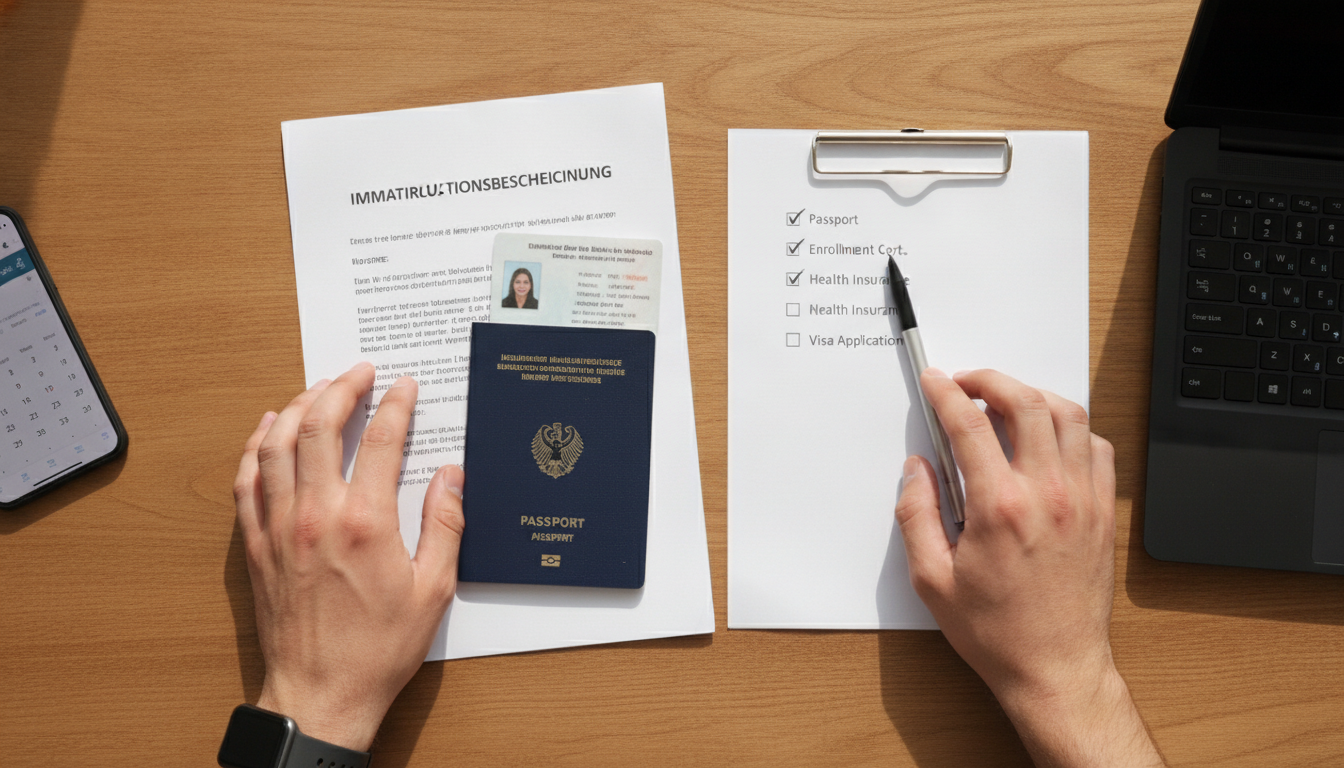
Many students lose time to avoidable mistakes. The most common one: submitting an outdated enrollment certificate. The certificate must not be older than three months. Request it from your university in good time.
The second classic: entering the wrong bank details. The IBAN must be in your name and with a German bank. Accounts at N26, DKB or other direct banks are fine as long as they have a German IBAN.
The third mistake: incomplete information about your studies. Give the full official name of your degree program, not just an abbreviation. For combined programs, list both subjects. If you're unsure, check your official enrollment certificate.
Alternatives to the KfW student loan for special situations
The KfW student loan isn't the best solution for everyone. If you're over 44, other options come into play. Private student loans often have more flexible age limits, but stricter credit checks.
The KfW student loan is less suitable for short-term funding gaps. A processing time of two weeks is too long for an acute shortfall. In that case, an education loan without BAföG with a shorter processing time is more likely to help.
Combine different sources of funding for maximum flexibility. The KfW student loan can be combined with BAföG, scholarships and part-time jobs. This diversification reduces your debt and gives you financial security.
Frequently asked questions about the KfW student loan application
How long does it take to process a KfW student loan application?
The average processing time is 2 weeks from a complete application. At peak times at the start of a semester, it can take 3-4 weeks. So submit your application at least 6 weeks before you want payouts to start.
Can I apply for the KfW student loan in a later semester?
Yes, you can apply in any semester as long as you are under 45. The maximum funding period of 14 semesters counts from the date of application, not from the start of your studies. So even in your 5th semester you can still receive 14 semesters of funding.
Which documents do I need for the KfW student loan application as a first-semester student?
As a first-semester student, you only need an ID card, an enrollment certificate and a German IBAN. You do not need proof of academic performance yet. The enrollment certificate must show the current semester and be no more than 3 months old.
Can I apply for the KfW student loan online?
Yes, the online application through the KfW grant portal is possible. You need an ID card with the online ID function or a qualified electronic signature. The online application is equivalent to a branch application and is processed just as quickly.
What happens if I drop out or switch programs?
If you drop out, you must tell KfW immediately. Payouts then stop at the start of the next month. If you switch programs, you can continue to receive funding if you submit the new documentation and are still within the maximum funding period.
Conclusion: the KfW student loan application is doable
The KfW student loan application may look complicated at first glance, but with this guide you'll get through it without trouble. Gather your documents, choose a partner bank and fill out the application carefully. Within two weeks you'll know whether you've been approved.
Keep this in mind for your financial planning: a student loan means debt after graduation. So combine it with other sources of funding and don't choose a monthly amount higher than you need. A well-thought-out strategy for studying debt-free helps you minimize the burden after you graduate.
Start your KfW student loan application now and secure the financial foundation for a successful degree. Still have questions? Use the free advice offered by the partner banks or contact the KfW hotline directly at 0800 539 9001.